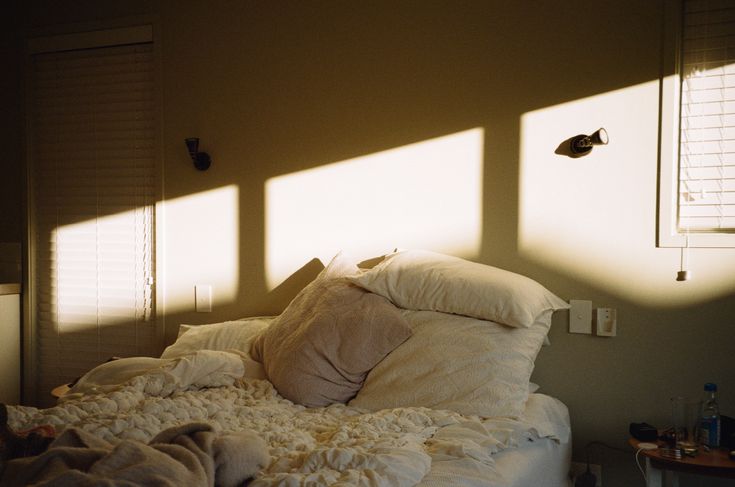
It's four in the afternoon on a Sunday. You're still in bed, the curtains are still shut, and the phone has been in your hand since some point this morning you can't locate. When you get up, you feel heavier than when you lay down.
You're tired for a reason, and wanting to do nothing is not a character flaw. Disappearing into a bed for a day is a reasonable response to a week that asked too much of you.
This isn't a piece about getting up at six to clean the kitchen. It's about why that way of resting leaves you emptier, and what one small change does.

Why bed rotting took off
It's the cheapest, easiest rest available. Nothing to book, nowhere to get to, no one to coordinate with, no version of it you can fail at. When you're depleted, an option that requires no decisions is hard to beat.
It's also common: in a survey of just over 2,000 US adults for the American Academy of Sleep Medicine, 24% of Gen Z respondents said they practise bed rotting.
The conditions behind it aren't mysterious either. Work presses harder, money feels less certain, and the phone has dissolved the line between being at work and off it. When no hour is reliably yours, a bed becomes the one place that clearly isn't work.
Checking out is not the same as recovering
Here's the distinction, and it's easy to miss because both feel like stopping.
One is disengaging from responsibility. The other is letting your nervous system actually downshift. You can do a great deal of the first while doing almost none of the second, and hours of scrolling in bed is the clearest example.
Your body is still. Your senses are not. A feed delivers a new emotional stimulus every few seconds, each small enough to feel like nothing and frequent enough to keep your attention working. Nothing in that stream is demanding, and nothing in it lets you settle either. You end up overstimulated and exhausted at once, which is a strange state to be in and a familiar one.
There's research pointing the same way. A diary study of 450 workers in South Korea compared smartphone breaks with what the authors called conventional breaks: walking, talking to someone, a nap. Both improved vigour, so the phone break wasn't useless. But at reducing emotional exhaustion, smartphone breaks were significantly less effective. The break that looked most restful did the least for the thing that was actually worn out.

Three signs your rest isn't working
You don't need a study for this. You need about ten seconds of honesty at the end of the day.
You get up heavier than you lay down. Real rest usually leaves some trace of lift. If the reliable outcome is more fog than you started with, it didn't land.
Time has gone missing. Not "I relaxed for three hours" but "it's dark and I don't know what happened." Losing track of time inside something absorbing is fine. Reaching the end of a day with nothing to point to feels less like rest than like a small loss.
There's guilt threaded through it. This has been studied directly. In a survey of 471 people about the previous day's media use, those already depleted were more likely to read their own downtime as procrastination, which produced guilt, which undercut the recovery the downtime was meant to provide. The people who most needed it were getting less of it. The study was self-reported and cross-sectional, so it can't prove the direction, but the pattern is recognisable. Guilt sits in the room with you and keeps you from settling.
What real rest looks like
None of this involves productivity. It's all still doing nothing, just a version your brain can register as nothing.
Give your senses a break
The single biggest change is removing the screen from part of the rest, not from the day. Twenty minutes is enough to notice the difference. Put the phone in another room rather than face down beside you, because the second version mostly tests your willpower when you have least of it. Same logic as a digital sunset in the evening.
Change the room
Beds are strongly associated with sleep, which is why sleep specialists are wary of long waking hours in them. Moving to the sofa or a chair costs nothing and changes something. Open the curtains and let your eyes look further than an arm's length.
Move a little
Not exercise. A ten-minute walk, a stretch, standing outside for a while. This is roughly the conventional break from that Korean study, the one that did most for exhaustion. Movement also breaks the stillness that's been making you feel heavier.
Do one slow thing
Cook something without a podcast on. Take a long shower. Put on an album and listen rather than using it as background. Anything with a single thread instead of forty. Attention rests when it has one place to be.
Let it be boring
Expect the first ten minutes to feel flat, maybe uncomfortable. That's not the rest failing. That's your brain coming down from a much faster input rate than it's used to, and boredom is what the descent feels like. It passes, and it's usually where the day starts to feel like yours again.

Keep the rot day, change the recipe
You don't have to give up the day in bed. It's doing something for you, and abolishing it in the name of optimisation would be its own kind of exhausting.
Split it instead. Half of it scrolling, guilt-free. Half of it without a screen: dozing, staring at the ceiling, listening to something, reading if reading appeals. And set one point where you leave the bed, even briefly, so the whole thing isn't one unbroken stretch.
The goal was never to rest less. It's to get up feeling lighter than when you lay down, which is what you wanted in the first place.
When rest becomes something else
An afternoon like this is normal. A whole Sunday is normal. Most people need one occasionally and shouldn't have to justify it.
It's worth paying gentle attention if it stretches across days and arrives with company: things you used to enjoy no longer appealing, mornings hard to face, messages unanswered because answering feels like too much. That combination is less about rest and more about something underneath it.
If that sounds like your last few weeks, talk to someone, a doctor or a therapist. Not because something is wrong with you, but because it's the kind of thing that gets easier with company and harder alone, and there's no threshold of suffering you need to reach first.
Next time, give the first twenty minutes to no screen at all. Then pick the phone back up if you want. Notice how you feel when you stand up.