
Screen break reminder apps exist because the underlying problem is real: long unbroken stretches at a screen genuinely do wear on focus, posture, and eyes. The category is worth taking seriously. It's also worth being honest about where the format tends to run into trouble.
What the category generally gets right
Most break reminder apps share a reasonable premise: left alone, people rarely stop on their own. A prompt at a set interval, every 20 minutes, every hour, whatever the setting, at least puts the option in front of you. Some pair this with a specific action, stretch, look away from the screen, stand up, drink water, which gives the pause a concrete shape rather than leaving you to invent one.
This is a genuinely useful mechanism. A calendar full of good intentions rarely produces the same result as a prompt that shows up uninvited at the right moment.
Where the format tends to struggle
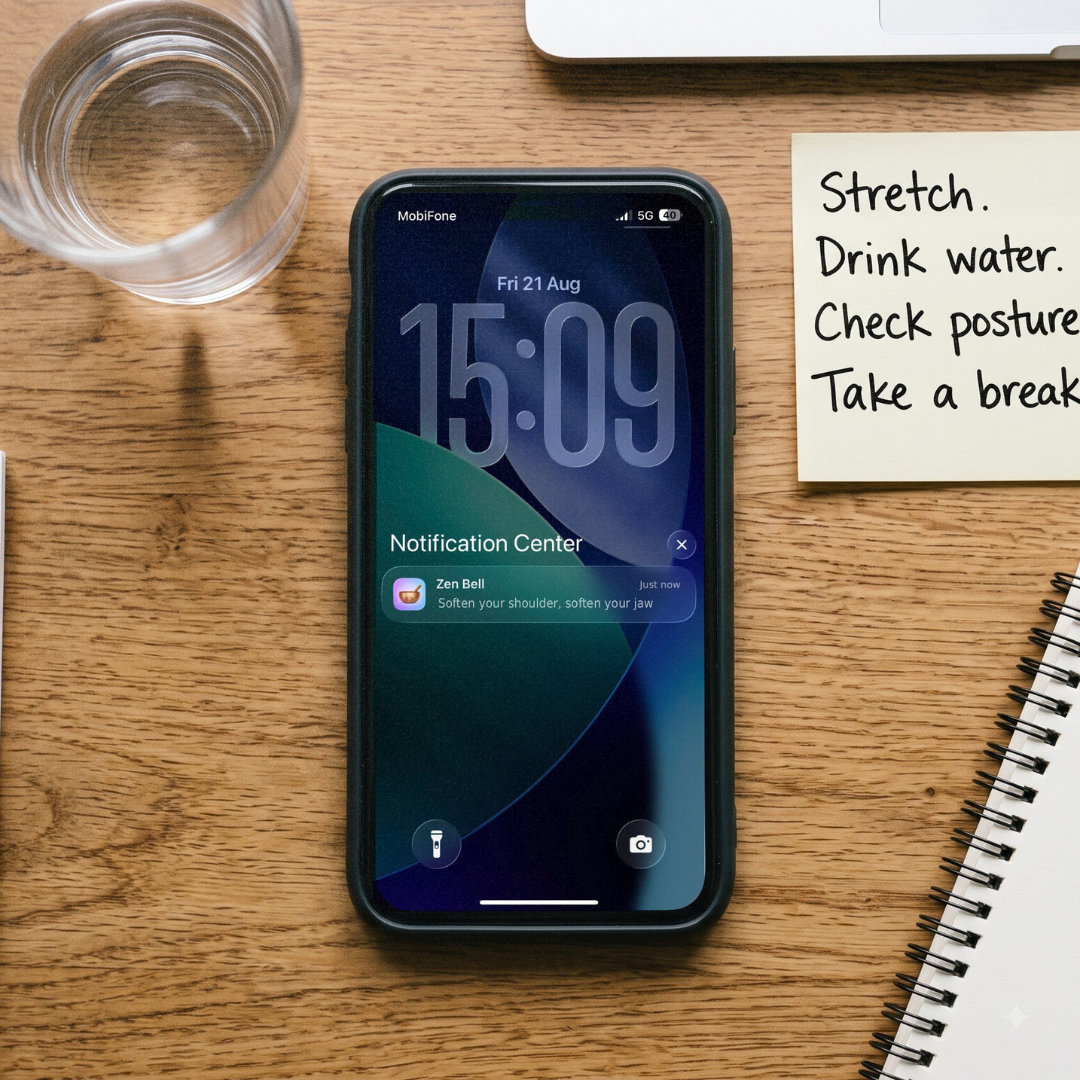
The common failure point isn't the idea. It's the delivery. Most break reminders arrive as a standard notification or a full-screen interruption, competing for attention in the exact same channel as every other alert on the phone. After a few days, many people learn to dismiss them with the same reflex they use on everything else buzzing for attention, without registering what the reminder actually said.
A second common issue is scope. Some apps stack multiple asks into a single reminder: stretch, hydrate, check your posture, breathe, look away from the screen, all in one prompt. Each addition is reasonable on its own, but together they turn a ten-second pause into something that reads more like a checklist, which tends to produce the opposite of calm.
A third, quieter issue is tone. Several apps in this category lean on streaks, scores, or gentle guilt to keep people engaged: how many breaks you've taken today, how many you missed, a badge for a full week of compliance. That framing borrows from habit-gamification more broadly, and it tends to turn a pause meant to reduce pressure into one more thing being tracked and judged.

What a bell-based approach does differently
A single, distinct sound, rather than a standard notification, tends to avoid the dismiss-without-reading reflex that generic alerts train. There's no icon to swipe away and no text to skim. The signal itself is the entire message.
Scope matters too. A bell that asks for one breath is easier to actually complete than a reminder asking for four different actions at once. Ten seconds is achievable in the middle of almost anything. A ninety-second checklist is a much bigger ask, and it's the size of the ask, more than the frequency, that tends to determine whether people keep the habit past the first week.
And on tone: a pause worth taking doesn't need to be scored. The value of the ten seconds doesn't depend on whether it's the fifth one today or the first one all week.
The honest tradeoff
None of this makes one approach universally better. Someone who wants a structured, multi-action break routine, a real stretch, a real walk to refill water, might prefer a fuller reminder format. Someone who wants the lowest possible friction, a single sound, one breath, nothing to track, tends to prefer something closer to a bell. The right choice depends on which kind of pause you're actually more likely to keep doing in month three, not month one.
Frequently asked questions
Do screen break reminder apps actually work? For many people, yes, at least initially. The core mechanism, an external prompt at intervals, is reasonable. Long-term adherence tends to depend more on how the reminder is delivered and how much it asks of you each time.
Why do people start ignoring break reminders after a while? Standard notification-style reminders often get filtered out by the same reflex used to dismiss every other phone alert. Reminders with a distinct, less generic signal tend to be noticed longer.
Is a bell-based reminder better than a full break reminder app? Not universally. A bell asking for one breath is lower friction and easier to sustain, but doesn't cover other needs like stretching or hydration that a fuller app might track.