
They're difficult to avoid now. A bowl gets struck at the end of a yoga class. Sleep videos open with that long metallic hum. Studios sell sound baths by the session, and your feed offers you frequencies that promise to fix things.
Which raises a fair question: is any of this actually studied, or is it a pleasant aesthetic that happens to photograph well?
The honest answer sits in between. There is real research on singing bowls, some of it recent, and it points in a consistent direction while carrying real weaknesses. This is a look at both.
What a singing bowl is
A singing bowl is a bowl, usually metal or quartz crystal, that produces a sustained tone when you strike it with a mallet or run the mallet around its rim. Metal bowls come from the Himalayan region, which is why they're often called Tibetan bowls, and they were used there long before they appeared in Western wellness settings. Crystal bowls are a modern invention with a cleaner, more piercing tone.
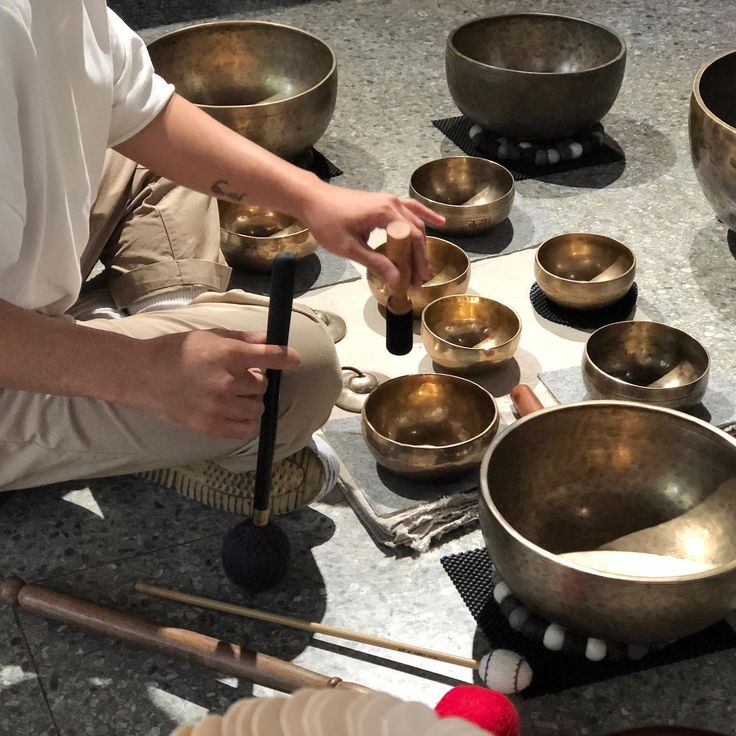
It's worth separating two experiences that get talked about together. One is a single bowl struck once, giving you a tone that rings out and slowly fades. The other is a sound bath: typically 40 to 60 minutes, often several instruments, with you lying on the floor while someone else plays. The research below is mostly about the second one.
What the research found
The most cited study comes from researchers at the University of California, San Diego, published in 2016.
Sixty-two adults, average age 49.7, took part in a singing bowl sound meditation lasting roughly 60 minutes, lying down in a half circle with their heads pointed toward the instruments. The session used tingshas, bells, crystal bowls and gongs, but Tibetan bowls accounted for around 95% of the playing time, and most of that was striking them with a mallet rather than the continuous rubbing sound people tend to imagine.
Compared with how they felt beforehand, participants afterward reported significantly less tension, anger, fatigue and depressed mood, along with an increase in spiritual well-being.
Two details are worth pulling out. The people who had never done this before showed a significantly greater drop in tension than the experienced participants, which is encouraging if you're wondering whether it's worth trying once. And participants weren't asked to do anything: no posture, no breathing technique, no clearing the mind. They lay there and listened.
A 2025 systematic review in the journal Healthcare gathered 14 quantitative studies published between 2000 and 2025, including three randomized controlled trials and two crossover trials. Most reported meaningful reductions in anxiety and depressive symptoms, alongside physiological changes including increased heart rate variability and lower heart rate. So the picture is reasonably consistent across a small body of work.
What the research can't tell us yet
Consistency is not the same as proof, and it's worth being blunt about the gaps.
The UC San Diego study was, in the authors' own words, a nonrandomized observational study without a control group. Everyone in the room knew they were at a sound meditation, everyone expected to feel calmer, and there was no comparison group lying quietly in silence. Expectation alone can produce a lot of what was measured.
The wider evidence base is thin. The 2025 review found sample sizes ranging from 12 to 81 people, designs too varied to pool into a meta-analysis, and almost no follow-up to see whether anything lasted beyond the session. Blinding is close to impossible, since you cannot give someone a placebo gong. The authors rated the overall certainty of the evidence as low to moderate and flagged every included study as high risk for selection bias, meaning people who volunteer for a sound bath study are probably not a random slice of the population. Outcomes also lean heavily on self-report questionnaires, which are useful but easy to nudge.
And the mechanism is genuinely unknown. Explanations involving specific frequencies, cellular resonance or brainwave entrainment are hypotheses repeated often enough to sound like findings. Treat confident explanations of how singing bowls work with more suspicion than the modest claim that people often feel better afterward.
Why sound may work when silence doesn't
Here's a plainer explanation that doesn't require any physics.
Plenty of people find sitting in silence makes their thoughts louder. Given nothing to attend to, attention goes looking, and it usually finds the unresolved conversation or tomorrow's list. We wrote about how unfamiliar real quiet has become in Why Silence Feels So Rare.
A long, slowly changing tone gives attention somewhere to rest. Following a sound is a much easier instruction than not thinking, which is why beginners often find it less frustrating than silent meditation.
There's also a structural benefit. A struck bowl fades to nothing on its own, which puts a natural boundary around a quiet stretch: you know when it started and when it ended, without watching a clock. That's the same logic behind using a bell at all, which we looked at in How Sound Calms Your Nervous System.
This is a reasonable explanation, not a proven one, but it doesn't require anything exotic to be true.
Bowl, bell, or recording?
A real bowl gives the richest sound and a vibration you can feel through your hands and the floor. It also costs money, takes up space, and takes practice to play without a harsh edge on the tone.
A single bell or small chime is the minimal version. It won't give you a 40-minute bath, but it does the job that matters most day to day: marking the beginning and end of a quiet stretch.
A recording is the most practical option and the most variable. A sustained low tone depends heavily on your speaker, and phone speakers flatten exactly the frequencies that make bowls pleasant. Headphones help.
If you're thinking of buying a bowl, go to a sound bath first. An hour in a room with real instruments will tell you more than any amount of reading, including this.
How to try it at home
Pick a fixed time, ideally the evening, which is easier to sustain than a vague intention to do it sometime.
Lie down or sit however you're comfortable. No particular posture is required, and the research participants were simply lying on the floor. Start with 10 minutes rather than the 40 or 60 used in studies, because a short session you'll repeat beats a long one you try once.
Then listen. That's the whole instruction. You're not trying to empty your mind, and there's no version of this you can do incorrectly. If you fall asleep, that's fine, and for a lot of people it's the point.
What this looks like on an ordinary evening
Almost nobody sets up a bowl on a Tuesday night. What tends to survive contact with a normal week is much smaller: one sound to open ten quiet minutes, and one sound to close them.
That's the whole idea behind Zen Bell, which we build ourselves, so read this as an interested party describing it rather than a recommendation. You choose how long the quiet stretch is. A bell opens it, a bell ends it, and nothing asks anything of you in between. No streaks, no badges, no leaderboards, nothing to scroll. Ten minutes in the evening, or one minute between two meetings.
It is not a sound bath, and it is not a substitute for the care mentioned below. It is a small bell amid big days.
A few honest cautions
A sound bath is not a treatment. Nothing in the research supports using it instead of medical or psychological care.
Some people find it genuinely unpleasant. Loud gongs and strong vibration can be uncomfortable if you're sensitive to sound, and if you have tinnitus or another hearing condition, keep the volume low and stop if it doesn't feel good. Leaving early is always allowed.
Be skeptical of the marketing. Claims about healing cells, repairing DNA or specific frequencies curing illnesses are not supported by evidence, and they tend to appear where prices are highest. The well-supported version is that people often feel calmer afterward, which is worth plenty on its own.
And if you're dealing with persistent anxiety or low mood, please talk to a professional. A bowl is a nice thing to have in your evening. It isn't care.
Worth trying, not worth overclaiming
The evidence is early and imperfect, and it agrees on one thing: a lot of people feel better after lying down and listening for a while. Whether that's the sound, the stillness, the hour off or the expectation, the research can't currently separate.
Fortunately this is cheap, safe and easy to test, and you're a sample size of one who cares about the result. Tonight, try ten minutes of just listening.