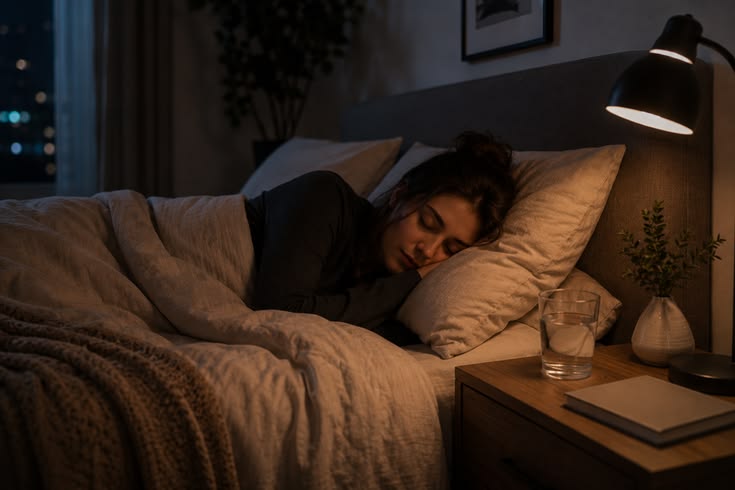
Look at a well-optimised nightstand. Magnesium, a mouth tape dispenser, blue light glasses, a white noise machine, a mouthguard, a herbal something. On the floor, a ring or watch charging for the night shift. In the morning, a number out of 100 telling you how you did.
Somewhere in all that, sleep stopped being the thing you fall into and became a thing you can fail at. And the more carefully people optimise it, the more anxious they seem to be about it.
So here's a sorting exercise: what the evidence actually supports, what you can quietly skip, and what the whole thing costs when it goes too far.
What sleepmaxxing is
Sleepmaxxing is treating sleep as a metric to be maximised, with its own rituals, products and scoreboard. Not "I want to sleep well" but "I want to raise my deep sleep percentage," which is a different relationship with the same night.
It has scale. In a 2024 survey of just over 2,000 US adults for the American Academy of Sleep Medicine, 55% of Gen Z respondents said they had tried a viral sleep trend. Tracker use has climbed steeply too, from 35% of American adults in 2023 to 48% in 2025, and most of those people say the data has changed something about how they sleep.
It's worth saying the obvious good thing first. A generation that treats rest as important rather than as laziness is a real improvement on one that treated four hours as a personality trait. The instinct is right. It's the scoreboard that causes trouble.
The part that actually works
The unglamorous core has decent support behind it, and almost none of it costs anything.
A fixed wake time, weekends included. This is the single most useful habit, because your body clock takes its cue from when light hits your eyes, not from when you go to bed. Sleeping until noon on Sunday moves your clock and makes Monday night harder.
Light early, dimmer late. Get outside in the morning if you can, even briefly, and bring the lights down in the last hour of the evening. We went through a fuller version of that in The Digital Sunset.
A dark, quiet, cool bedroom. Cooler than feels intuitive. Noise reduction has some of the strongest evidence of any environmental change.
A bed for sleeping. Working, eating and scrolling in bed weakens the association between the bed and sleep, which is exactly the association you want strong. It's also why bed rotting leaves people feeling worse.
An earlier caffeine cutoff than you'd expect. Caffeine has a long half-life, so an afternoon coffee is still in your system at bedtime even when you don't feel it.
One honest caveat, because it matters. These habits help people who sleep reasonably well already. For genuine chronic insomnia, the American Academy of Sleep Medicine's 2021 guideline specifically recommends against sleep hygiene as a stand-alone treatment, warning that relying on it can delay something that works. More on that at the end.
The part you can skip
Sleep supplements you prescribed yourself. Melatonin in particular is not the harmless sweet it looks like. A 2023 analysis in JAMA bought 25 melatonin gummy products and found 22 of them inaccurately labelled, with actual melatonin ranging from 74% to 347% of the stated dose. One contained no detectable melatonin at all. That's not an argument against melatonin as a molecule, it's an argument for talking to a doctor or pharmacist rather than a comments section.
Mouth taping. This one deserves naming because it's both popular and risky. A 2025 systematic review in PLOS ONE pulled together the 10 available studies, 213 participants in total, and rated every one of them poor quality. Only two of six studies measuring apnea severity found significant improvement, both in mild cases, and the authors judged the benefit not clinically significant. Four of the studies raised safety concerns, including a risk of asphyxiation in people with nasal obstruction, which is a thing you can have without knowing it. Worse outcomes were also seen in more severe cases.
The aesthetic layer. Candles, the amber mocktail, matching linen pyjamas, the playlist. There's nothing wrong with any of it, and a pleasant wind-down genuinely helps you settle. Just don't mistake it for the mechanism. A dark room and a consistent wake time do more than a beautiful tray ever will.
When optimizing backfires
Here's the trap in one sentence: worrying about sleeping well is one of the more reliable ways to sleep badly.
Sleep researchers have a name for the version that involves trackers. Orthosomnia is anxiety about your own sleep data, and in a 2026 study of 1,280 US adults, 32.4% used some digital sleep tracking, and among those, 30.9% showed risk indicators for it. The authors noted that was roughly double earlier estimates. It's a conference abstract rather than a full paper, so treat the number as a signal and not a settled figure, but the direction fits what sleep clinicians have been reporting for years.
The mechanism isn't mysterious. A score turns a subjective thing into a test result. You wake up feeling fine, read 62, and reinterpret the morning. Then at 11pm you start monitoring how asleep you are, which is an activity fundamentally incompatible with falling asleep.
If your evenings have picked up a low hum of dread about the number, take the tracker off for two or three weeks and go by how you feel when you wake up. You can always put it back on.
Rest shouldn't turn into one more thing you're being assessed on.
The five-minute version
If you strip it all back, here's the whole routine.
Wake at the same time tomorrow as today. Get some daylight in the first hour. Turn the screens off twenty minutes earlier than usual. Keep the room dark and cool. And do the same few things in the same order before bed, whatever they are, so your body gets a signal it recognises.
That's it. Five things, none of them for sale, and between them they do most of the work that a nightstand full of products is advertising.
When to see a doctor
Some sleep problems aren't habit problems, and no routine will fix them.
Worth a conversation with a doctor: trouble falling or staying asleep most nights for several weeks, loud snoring with pauses in breathing or gasping, or persistent daytime sleepiness despite giving yourself enough hours. Sleep apnea in particular is common, frequently missed, and very treatable once found.
For long-running insomnia, ask specifically about cognitive behavioural therapy for insomnia. It's the recommended first-line treatment, it works for most people who complete it, and it's what all the sleep hygiene advice in the world is not a substitute for.
Good sleep doesn't need a kit. It needs regularity, which is much less interesting to buy and much more effective.
Tonight, keep exactly one thing: set the alarm for the same time you got up today. Start there and let the rest go.