
Most advice about focus starts from the same premise: interruptions are the enemy, and the goal is to eliminate as many as possible. That's a reasonable instinct, but it isn't quite what the research says. The more precise finding is narrower and more interesting: it isn't interruption itself that costs you focus. It's what the interruption asks you to do.

What attention residue actually is
In 2009, organizational psychologist Sophie Leroy published research describing something she called attention residue. The finding, since replicated and built on by other researchers, was straightforward: when people switch from one task to another before finishing the first one, part of their attention doesn't fully make the switch with them. It stays behind, quietly working on the unfinished thread, and that leftover attention competes with the working memory the new task actually needs.
In practice, this shows up as the fog you feel in the first few minutes after a meeting ends, or the sluggishness right after you finally close a browser tab you'd been putting off. You're technically done with the old task. Cognitively, you're not quite there yet.
Why the type of interruption matters
Here's the part that's easy to miss: Leroy's research, and the task-switching literature that followed it, is mostly about interruptions that ask you to begin something. Check a message, and you're pulled into reading it, deciding whether to respond, maybe starting to draft a reply. Open a new tab, and you're one click away from a new task entirely. Each of these hands you a small amount of new cognitive work on top of whatever you already had open.
A notification that asks you to process new information is fundamentally different from a signal that asks you to do nothing except notice where you already are. That distinction rarely gets made explicit, probably because most digital interruptions fall into the first category by default. A ping usually comes attached to content: a message to read, a like to acknowledge, a headline to skim. The content is the point.

A pause that doesn't ask you to start anything
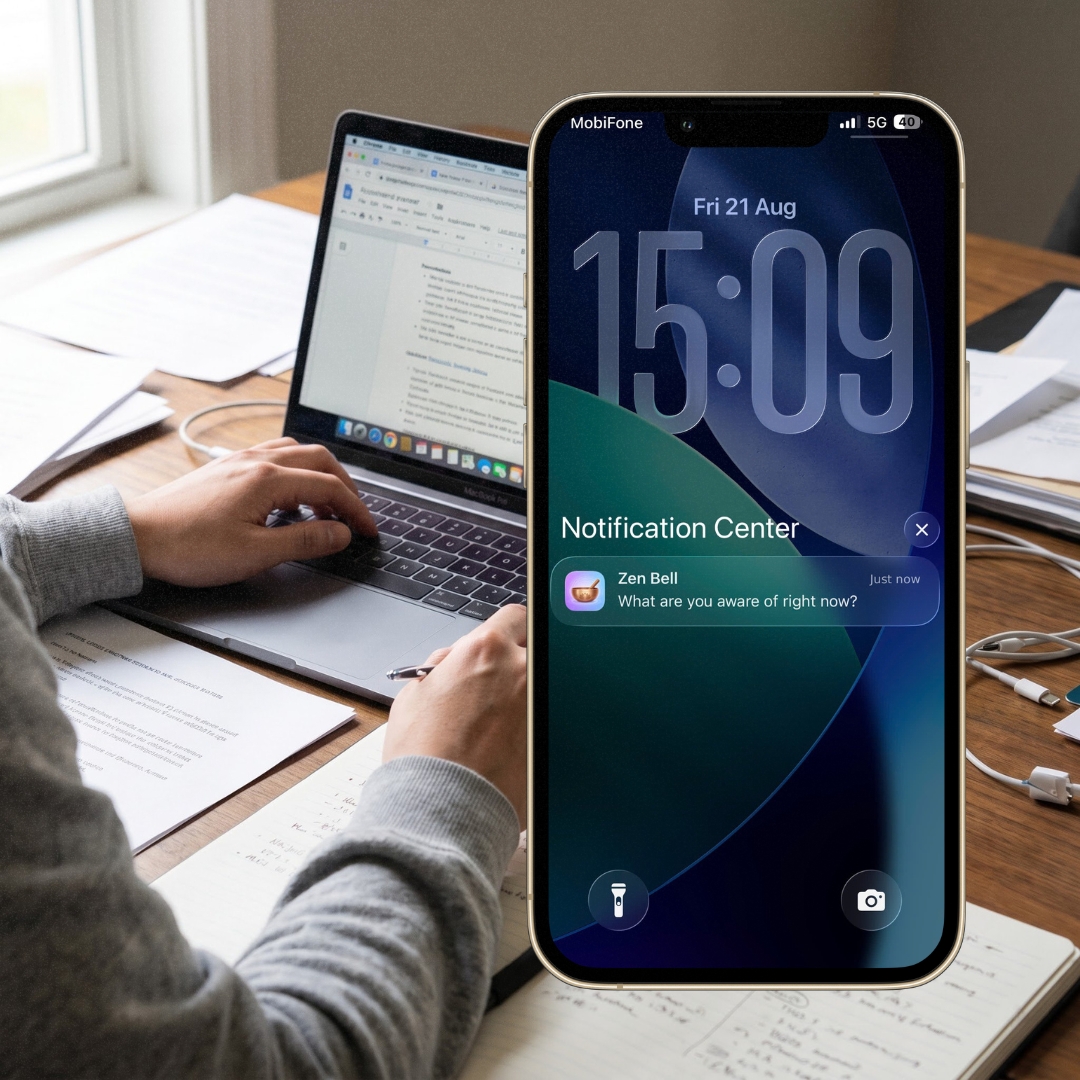
This is the useful distinction for thinking about a bell that rings on an interval through the day. It doesn't hand you anything to read, decide, or respond to. There's no content attached to it, no thread to pick up, no task waiting on the other side. The only ask is a breath, and then you're free to go back to exactly what you were doing.
That's a meaningfully different category of interruption than the ones the attention-residue research is describing. The research is about the cost of switching into new cognitive work mid-task. A bell that asks for nothing but a breath isn't asking you to switch into anything. If it works the way it's designed to, you notice it, take one breath, and return to the same task with your attention basically undisturbed, rather than carrying a new open loop forward the way a message or a notification would.
What this doesn't mean
It's worth being precise about what this argument does and doesn't claim. This isn't a claim that a bell eliminates attention residue from your day, or that it counteracts the cost of task switching elsewhere. Plenty of unavoidable interruptions, real messages, real meetings, real requests, still carry the cognitive cost the research describes. A soft bell doesn't undo that.
What it does suggest is that not every interruption belongs in the same category, and it's worth noticing which kind you're designing your day around. A system built entirely on pings that each demand a decision is a different experience than one that occasionally asks for nothing but a breath.
A distinction worth noticing
The next time something interrupts your focus, it's worth asking what it's actually asking of you. Some interruptions want your working memory. Others just want ten seconds of your attention and nothing else. They aren't the same thing, even though they can feel similar in the moment they arrive.
This is part of the thinking behind how Zen Bell's interval bell is designed: a sound that asks for a breath, not a task.